Case study
Nislo
A writing app for memoir where AI teaches and never writes.
The short version. I wanted to write a memoir and felt lost. I had years of journals and no way to turn them into a book. Every AI tool I tried either forgot my story between sessions or offered to write it for me. So I designed and built Nislo: a writing space that remembers the whole book, helps you organize what you have, and coaches you to become a better writer, while every sentence stays yours.
The problem
A memoir isn't missing material. It's drowning in it. Real people, fragmented memories, decades of timeline, and a story you're still figuring out as you write.
The tools I tried were bad matches. Chat assistants are stateless, so every session I pasted a chapter in fresh and it had no idea who my characters were or what happened in chapter three. Fiction writing apps kept trying to turn my life into a plot. Word processors organize, but they don't help you see anything.
What I needed was something that remembers the whole book, shows me patterns I can't see from inside one chapter, and gives feedback built for memoir.
What memoir writers told me
I was the first user, but I didn't want to build only for myself. I ran voice-of-customer research, collecting what memoir writers say in their own words about where they get stuck, what they dislike about their tools, and how they feel about AI. I also audited five AI writing apps to see what they promise.
- "Where do I start?" is the first wall. Writers have piles of fragments and no way in.
- Writers don't distrust AI. They distrust AI that writes for them. Memoir depends on voice, and they're afraid of losing theirs.
- Two groups need this most: aspiring authors who want to finish and publish, and people who write to make sense of their own story.
- Privacy is a real fear. Writers worry about their story being used to train AI, and about family reading a draft too early.
The principle: AI teaches, never writes
That research became the product's one rule. Most AI writing tools draft, expand and rewrite your prose. Nislo doesn't. I believe the act of writing is what changes you, so the AI works as an editor and a coach. It reads, notices, asks and teaches. It never produces sentences you didn't ask for.
That rule shaped everything else, from the features down to the colour system.
Key decisions
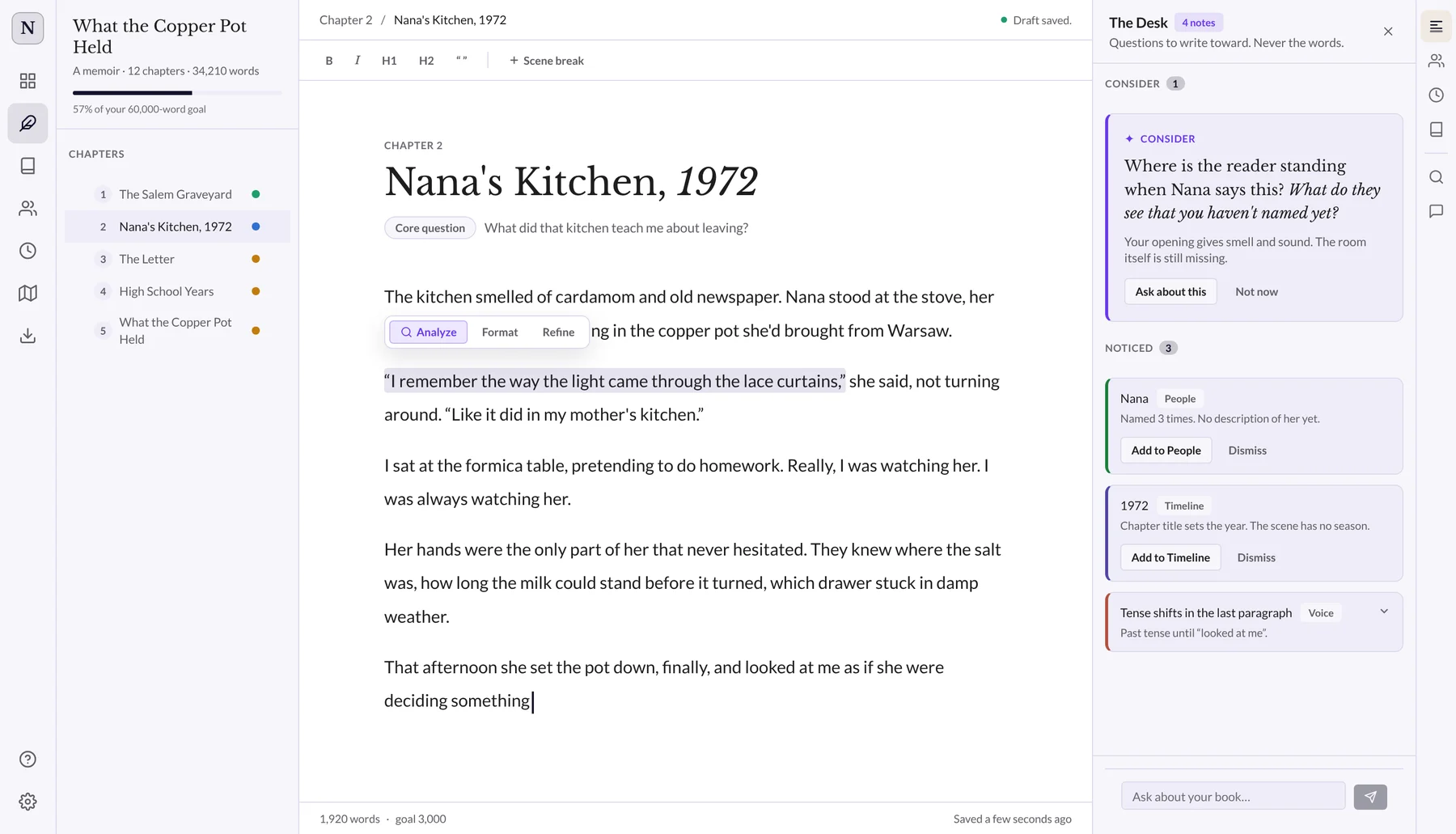
- A "book brain" instead of a chat window. Every chapter gets a saved summary, so when you open any chapter the AI already knows your people, your timeline and what you've established. It reads like a collaborator who has read the whole manuscript.
- Four editors, not one assistant. A developmental editor for structure, a line editor for sentences, a sensitivity reader for how real people are portrayed, and a writing coach who teaches craft by name. They give different, sometimes conflicting feedback on purpose, and the writer chooses which one to hear.
- You can always tell what's AI and what's yours. In the design system, violet means AI and only AI. The writer's own actions never use it. Colour is assigned by intent, so the boundary is visible on every screen.
- The right model for the moment. A fast model handles real-time work like spotting names and dates as you type. A balanced one gives editorial feedback. The most capable one is saved for whole-manuscript analysis. That keeps typing smooth and costs sensible.
- No blank page. A short warm-up prompt before each chapter gets you writing in minutes, which answers the "where do I start" wall directly.
- From desktop to web. I first built it as a private, offline Mac app because memoir is sensitive. Then I moved it to the web, because beginner writers drop off at downloads and security prompts, and a login works on any computer. The trade-off is that I now store manuscripts, so strict per-user access rules and a promise to never train AI on anyone's writing became requirements.
The work
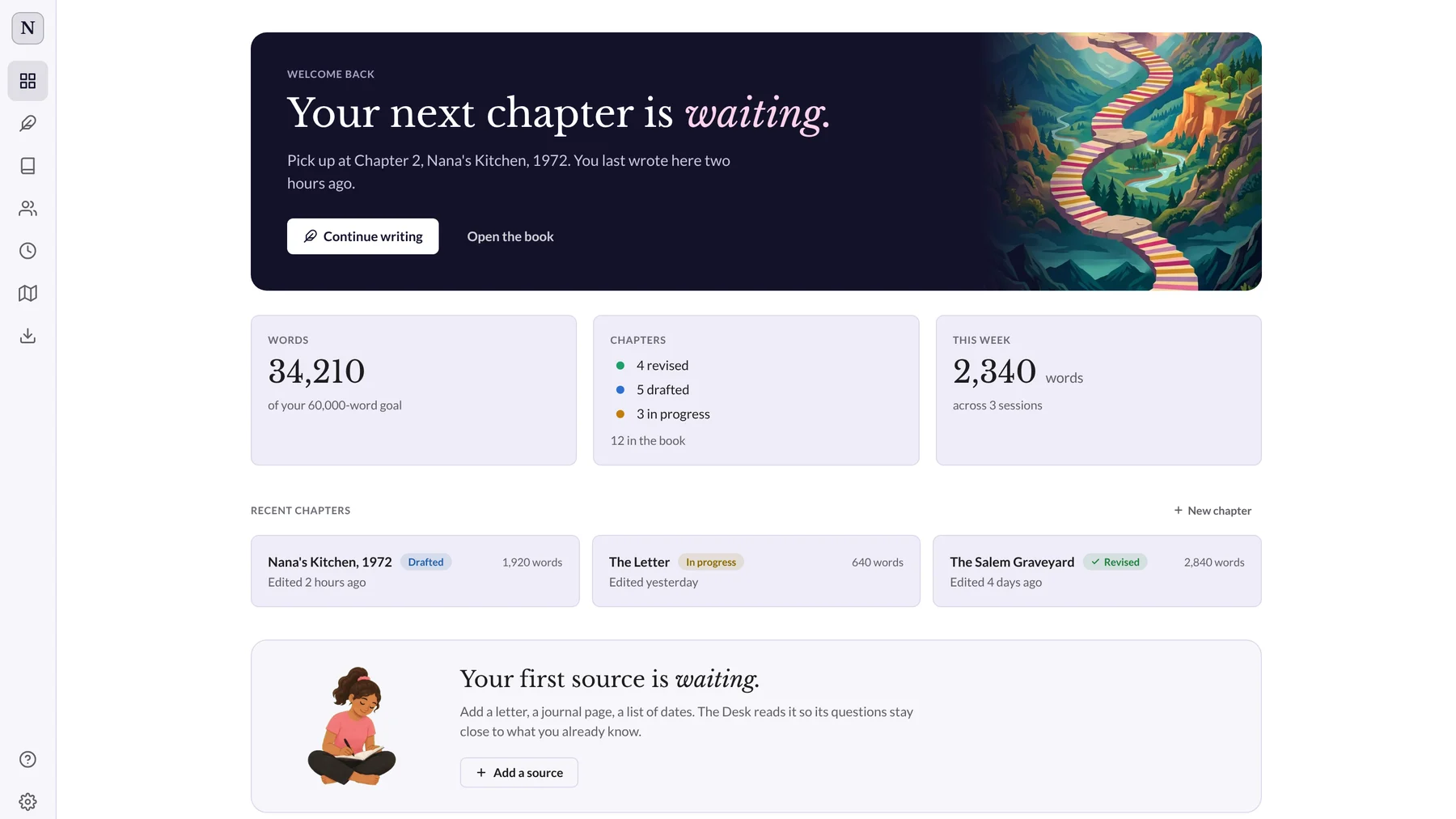
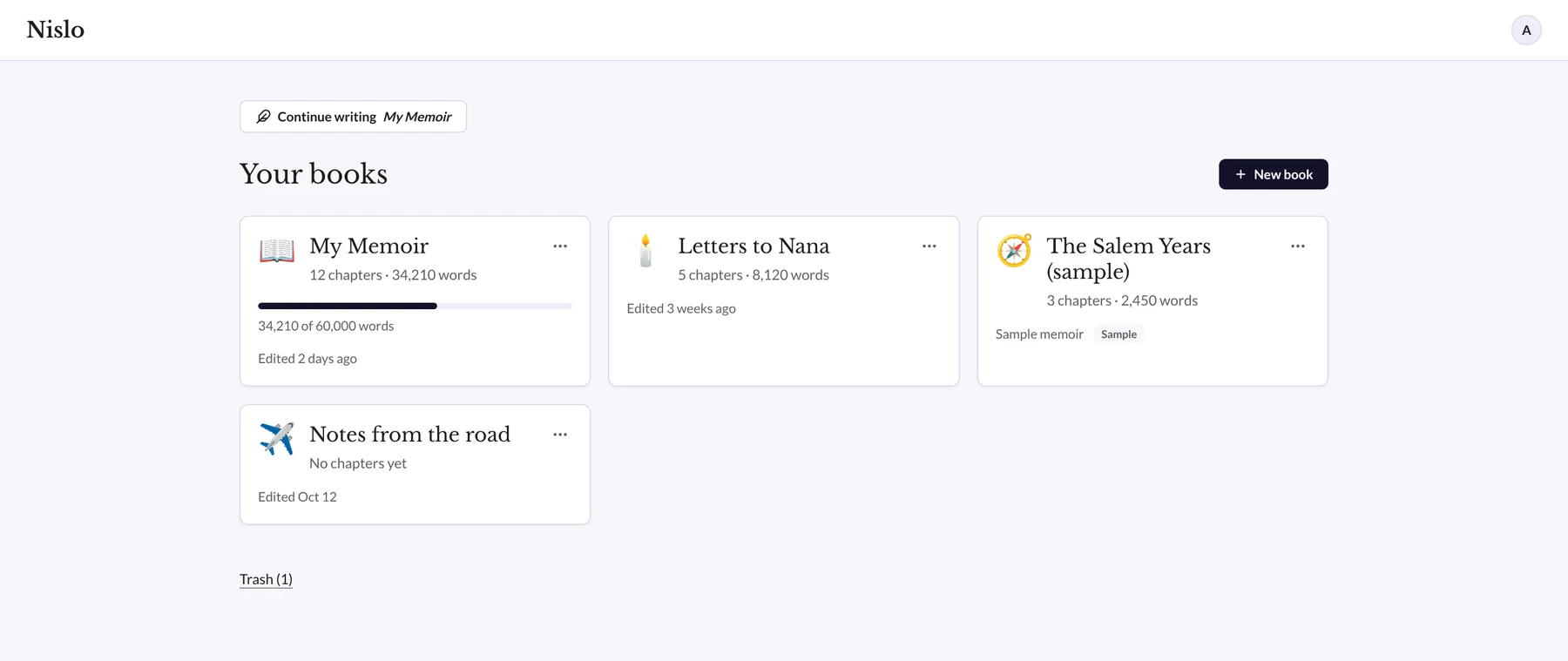
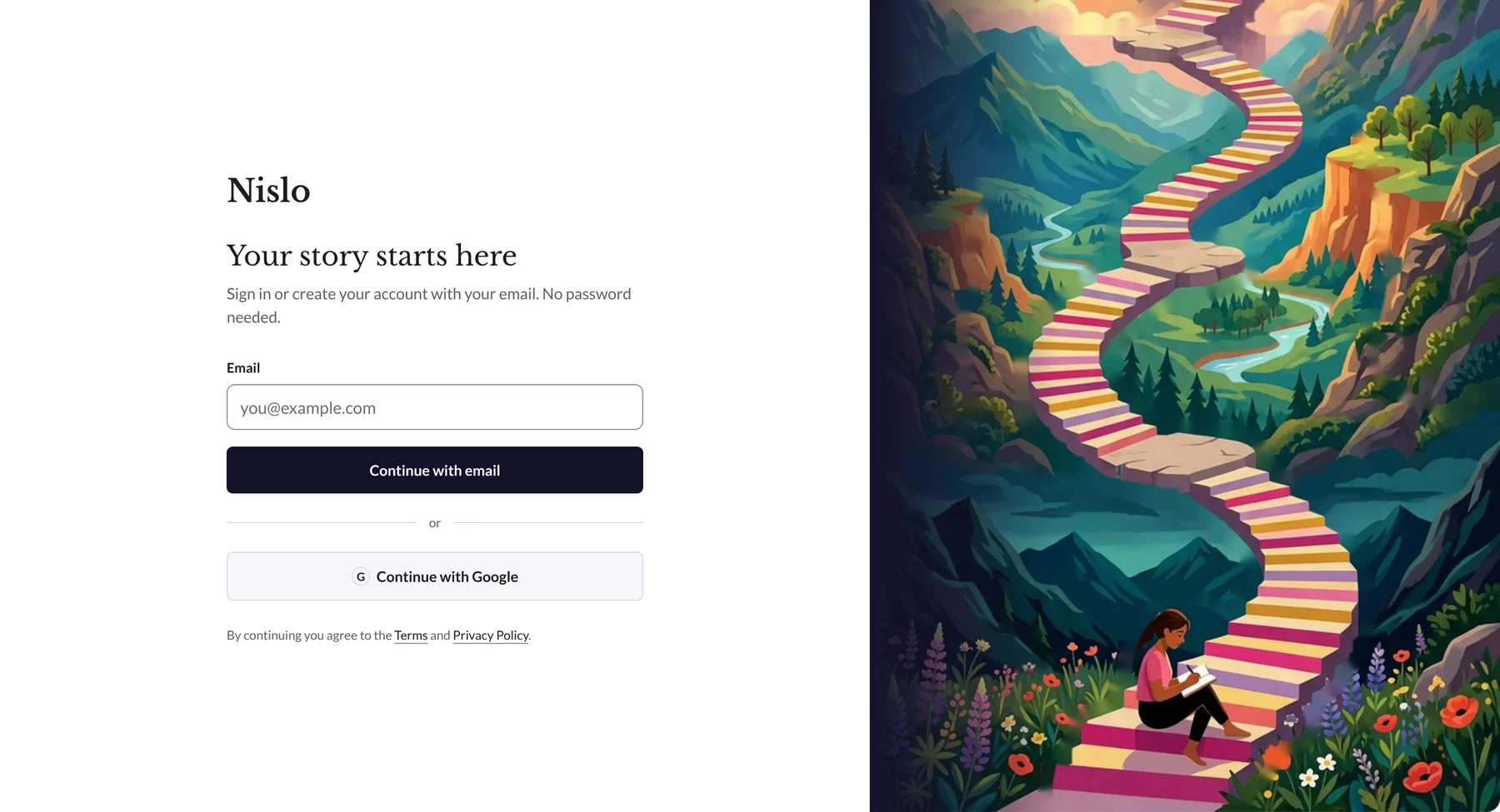
Designs for the web app, shown with sample content.
The design system was the project inside the project
I built Nislo with AI coding agents, and early on I let them work without a written design system. Each choice they made was reasonable. Together they were incoherent. One audit found 103 text styles hardcoded across the component library, so changing one thing meant hunting through 103 places.
I fixed it with short, structured design system sprints: audit the violations, complete the component stories, test, commit. Colours, shadows and fonts now come only from named tokens, and a check fails the build if a raw colour slips in. It felt like overhead at first. It's what let later features get built in hours instead of days.
The brand
The name blends Nisaba, the Sumerian goddess of writing, with the lotus, which blooms out of mud. The landing page, "The Climb", shows a writer making her way up a mountain one step at a time.
The messaging has a rule too. Nislo never promises to heal or transform anyone. It says that writing itself does that, which is the real reason the AI doesn't write for you.
Where it is now
The desktop app reached a ship-ready state, and it's the base for the web app I'm building now. The landing page is live at nislo.ca with a waitlist open for the beta. [Add: waitlist numbers or early tester reactions when you have them.]
What I learned
Building a tool for yourself is a shortcut to clear requirements, because you've lived with the gap. But the research is what turned my own frustration into a position: writers want a teacher, and they don't want a ghostwriter. And when you build with AI agents, the design system is what keeps the product coherent as it grows.